
The Area under the Grief Curve


The night after the funeral, Rhea sat on the kitchen floor surrounded by his things, his coat still holding the shape of his shoulders, the half-finished crossword, the mug with the chip she had always meant to throw away. The weight of a life without him felt too vast to carry. She could not move. Her younger daughter found her there and sat beside her in silence. After a long time, the child whispered, "Mommy, when my puzzle is too hard I do one tiny piece at a time. Then another. And another. Until the whole picture comes back." Rhea almost smiled through the tears. The next morning she didn't try to face the entire future. She only washed one cup. The day after, she folded one shirt. She answered one letter. She walked to the end of the street and no farther. Each act was small enough to bear, almost nothing by itself. Days became weeks, weeks became seasons. The tiny pieces accumulated without her noticing at first: a single breath taken without pain, a meal finished, a memory remembered with more tenderness than agony. Slowly, almost invisibly, the fragments joined. The unbearable whole began to take shape, not a life she lost, but a life she still inhabited. Years later, standing in the same kitchen with light pouring through the window, Rhea understood. The grief was never something she could solve at once. It had yielded only when she divided it into infinitely many moments small enough to hold, healed each one, and let them reassemble into something that could carry her forward. That, she realized, is how the heart learns to live again.
Rhea seemed to be very intelligent. She got over pain using the Infinity principle. It's a revolutionary idea that helps us to solve complicated problems. Whenever you encounter a complicated object, imagine breaking it into infinitely many smaller pieces. Analyse these pieces and then put the same answer back together. This single idea powers almost all of calculus. For instance, a circle is difficult to measure, an irregular curve is difficult to analyse, and the motion of a planet is difficult to predict. But if each is divided into infinitely many pieces, every piece becomes simple. Instead of fighting complexity, calculus transforms complexity into simplicity.
Humans naturally understand finite quantities, such as 10 apples, 50 students, or 100 stars. Infinity has no end. It raises some important questions in the mind:
Can something really have infinitely many parts?
Can we ever finish infinitely many steps?
Is infinity even a number?
These questions puzzled philosophers for over two thousand years. Infinity is strange because it behaves differently from ordinary numbers. For example, 1,2,3,4,... never ends. You can always add one more number. Infinity is therefore a process rather than a destination.
Imagine a circular pizza. It's difficult to directly find its area. Now imagine cutting it into slices. The four slices produce a rough rectangle. With eight slices, the rectangle looks better. With sixteen slices, it becomes even better. As the number of slices increases without limit, the zigzag edges become flatter. Eventually, the rearranged pizza approaches a perfect rectangle. The rectangle has height equal to the radius and width equal to half the circumference.

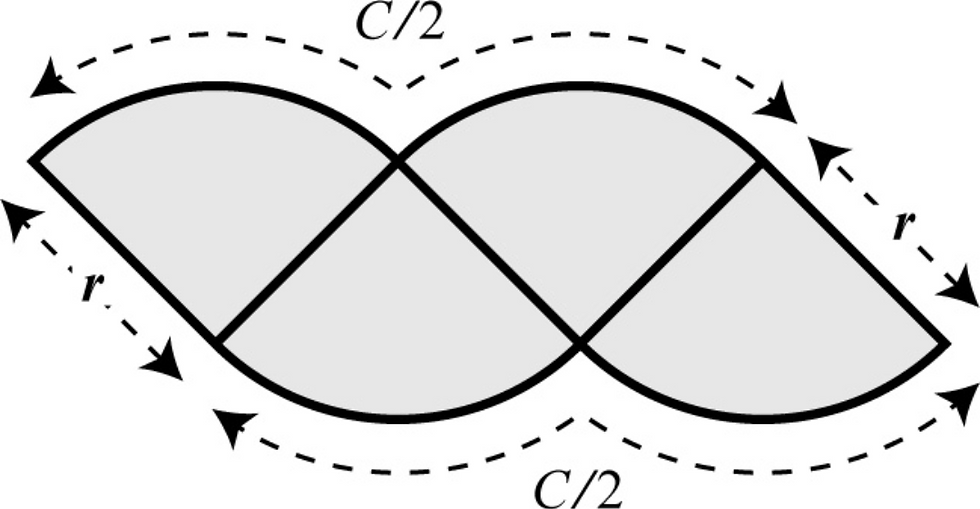

Source: Infinite Powers
Area of a circular pizza = Height × Width = r×π×r = πr²
Let's understand it with another example. Imagine walking halfway towards a wall. First move 1/2 meter, then 1/4 meter, then 1/8 meter, and so on. The total distance becomes equal to 1/2 + 1/4 + 1/8 + 1/16 + ... = 1.
Why is it equal to 1?
S = 1/2 + 1/4 + 1/8 + 1/16 + ...
Multiply both sides by 2; we get
2S = 1 + 1/2 + 1/4 + 1/8 + 1/16 + ...
2S = 1 + S
S = 1
There are infinitely many movements. Does that mean you never reach the wall?
No. The total distance equals exactly 1 meter. An infinite process can produce a finite answer. There is a famous paradox known as Zeno's paradox. Imagine the fastest runner in history. Before reaching the finish line, he must travel halfway. Before that, half of the remaining distance. Then half again. There are infinitely many halfway points.
How can the runner ever finish?
Zeno argued that he can't. Calculus explained the mistake. Although there are infinitely many intervals, their lengths shrink rapidly. Adding them gives a finite total. Infinity has never been the obstacle. The misunderstanding of infinity is.
Nature isn't confined to mathematics, and it behaves continuously. Examples include flowing rivers, ocean waves, falling rain, air movement, light, heat, and population growth. All of these involve continuous change, and infinity appears naturally. Calculus consists of two complementary steps: break apart and rebuild. That is why it has two main branches:
Differential Calculus: Break change into tiny steps. For example, slice a curve, slice time, slice space, and slice motion.
Integral Calculus: Adding infinitely many tiny pieces back together.
Complex curved shapes can be understood by dividing them into infinitely many tiny simple pieces. This is how we harness infinity. Infinity is not something to fear or avoid. Instead, it can be used to solve problems that seem impossible. The Greeks knew how to calculate the area of simple figures like rectangles and triangles. But they had no formula for a circle. A difficulty is obvious because a circle has no straight edges. Without straight edges, it is difficult to measure its area. For centuries, this remained one of mathematics greatest unsolved problems.
Archimedes solved it through an ingenious technique known as the method of exhaustion. It says to keep removing the error until nothing significant remains. He asked, what if I pretend that the circle is made from many straight sides? Instead of studying the circle directly, he placed polygons inside it. He started with a square, hexagon, octagon, 16-sided polygon, 32-sided polygon, etc. Each polygon looks more like a circle. He already knew the area of the polygon. As the number of sides approaches infinity, the difference between the circle and the polygon becomes almost impossible to detect, and he found the area of the circle.
One of Archimedes' greatest achievements was calculating π. Today π = 3.14159265... Archimedes didn't have calculators. He didn't even have algebra. Instead, he surrounded the circle with polygons. An inner polygon gives a value that's too small. An outer polygon gives a value that's too large. Therefore, the true value of π lies between them. After increasing the number of sides to 96, he proved 3.1408 < π < 3.1429. This astonishing estimate was the most accurate in the world for centuries.
There is a popular principle known as Cavalieri's Principle. It says that two different solids have the same height and identical cross-sectional area at every level. Then their total volumes must be equal. Modern calculus still uses this principle. Modern CT scanners and MRI machines reconstruct three-dimensional organs from many thin slices using the same idea.
Unlike many Greek mathematicians, Archimedes combined mathematics with physics. He imagined balancing shapes on a lever. If two complicated objects balanced exactly like simpler ones, they must have the same area or volume. These mechanical insights often guided his geometrical proofs.
For almost 2000 years, Europeans accepted the teachings of Aristotle. He believed that heavy objects fall faster than light ones, heavenly bodies are perfect and move in perfect circles, Earth is the center of the universe, and motion naturally stops unless something keeps pushing. These ideas seemed reasonable because they matched everyday experience. A cart eventually stops, feathers fall more slowly than stones, and the sun appears to move across the sky.
But there was a problem. Nobody had actually measured motion carefully. People trusted philosophy more than experiments. This was the greatest obstacle to scientific progress. Nature doesn't care about opinions; it follows mathematical laws. Galileo changed the rules; he asked a revolutionary question: Instead of arguing about motion, why don't we measure it?
Galileo performed multiple experiments. Since falling objects move too quickly to measure accurately, he slowed gravity down by rolling balls down inclined planes. By stretching time, he could observe motion. He discovered something astonishing. During equal intervals of time, the first second travels 1 unit, the second travels 3 units, the third second travels 5 units, and so on. The distances formed the sequence of odd numbers. Adding them gives
1 = 1²
1 + 3 = 4 = 2²
1 + 3 + 5 = 9 = 3²
1 + 3 + 5 + 7 = 16 = 4²
1 + 3 + 5 + 7 + 9 = 25 = 5²
He realised the distance travelled is proportional to the square of time. This became one of the quantitative laws of motion. Before Galileo, people described motion. After Galileo, motion became measurable. Instead of saying the ball falls quickly. Science could now say the distance increases like the square of time. He noticed another puzzle. When a ball rolls downhill, it starts slowly, becomes faster every moment, and never has a constant speed.
So what does its speed mean at one exact instant?
This question could not be answered using ordinary arithmetic. Average speed was easy, unlike instantaneous speed. This mystery eventually required calculus. The need to describe continuously changing quantities is what eventually gave birth to differential calculus.
One famous story describes Galileo watching a swinging chandelier in a church. Although the swing became smaller, each swing took nearly the same amount of time. This suggested that pendulums have a remarkably regular rhythm. This insight later led to accurate pendulum clocks, dramatically improving timekeeping and navigation.
While Galileo studied falling bodies, Kepler studied the heavens. Astronomers had struggled to explain why planets sometimes seemed to move backward across the sky. Using years of careful observations collected by Tycho Brahe, Kepler discovered three laws:
Planets move in ellipses, not circles.
A planet sweeps out equal areas in equal times.
The farther a planet from the Sun, the longer its orbital period.
These laws perfectly described planetary motion, even though Kepler didn't yet know why they worked.
Galileo studied objects falling on Earth, and Kepler studied planets in space. They looked like completely different problems. Newton's great insight was that they were governed by the same universal laws. The force that pulls an apple downward is the same force that keeps the motion in orbit. Calculus became the mathematical language that connected these discoveries.
Galileo deliberately ignored unnecessary complications. He ignored air resistance, bumps, friction, and imperfections. Instead, he asked, What happens in the simplest possible world? This simplification was not a weakness. It revealed the underlying law: understand the ideal case first and then add complexity. Galileo introduced a new way of thinking. Observe nature, measure carefully, search for mathematical patterns, and test predictions with experiments. This approach replaced authority with evidence and philosophy with mathematics. It marks the beginning of modern science.
Differential calculus was not invented overnight. It emerged after several mathematical revolutions had prepared the way. Those revolutions include symbolic algebra, coordinate geometry, understanding curves, studying tangents, and optimization. Only after these developments could mathematicians think about instantaneous change, the core idea of differential calculus.
Why did differential calculus come later than integral calculus?
Today, students learn derivatives and integrals. But historically, ideas like integration appeared much earlier. Ancient mathematicians such as Archimedes already knew how to calculate areas, volumes, and centers of gravity using methods that resemble integration. This is because measuring areas required geometry, whereas finding rates of change required much more sophisticated methods.
Early algebra looked different from modern algebra. Instead of writing x² + 5x = 6, mathematicians wrote sentences describing the relationships. Everything was written in words. For example, a square and five roots equal six. Imagine trying to solve difficult equations entirely with sentences. It was slow, cumbersome, and hard to generalize. Modern algebra depends upon symbols. We write x , y , + , - , = , etc. instead of long sentences. The symbols allow the brain to manipulate ideas rather than language. The invention of symbolic notations was comparable to inventing programming languages for computers. Without symbolic algebra, calculus would have been impossible.
Over centuries, European mathematicians gradually adopted Arabic numerals, symbolic notation, and improved algebraic methods. Eventually, equations became objects that could be transformed almost mechanically. Instead of solving one specific problem, people could solve entire classes of problems. This abstraction is one of mathematics' greatest achievements.
Ancient Greek geometry had reached extraordinary heights due to Archimedes, Apollonius, and Euclid. Progress slowed dramatically after them. Geometry remained largely synthetic. Everything relied on diagrams, construction, and logical proofs. It was elegant but not flexible. Algebra, meanwhile, was becoming faster every century. It surpassed geometry in its ability to solve complicated problems.
Around the early seventeenth century, René Descartes and Pierre De Fermat realized that geometry and algebra are actually the same subject viewed differently. Suppose you draw two perpendicular axes, horizontal and vertical. Every point now has two coordinates (x,y). Suddenly, a curve becomes an equation. Instead of drawing circles, you can write x² + y² = 25. Instead of drawing parabolas, you write y = x². It means every geometric problem became an algebra problem. Conversely, every algebraic equation becomes a picture. This is the birth of analytic geometry.
Differential calculus studies curves, slope, and motion. Without equations representing curves, there is nothing to differentiate. Coordinate geometry supplied the language calculus desperately needed. Ancient geometry already knew tangent lines. For circles, finding a tangent was easy. But what about complicated curves?
Consider y = x². What is the slope at exactly one point? Not nearby, not approximately. This question haunted mathematicians.
Fermat discovered an ingenious method for finding tangents before calculus formally existed. His strategy was to roughly
Compare two nearby points.
Pretend these differences are extremely small.
Manipulate the algebra.
Eliminate negligible terms.
Obtain the tangent slope.
It resembles differentiation almost perfectly. Fermat lacked modern notation, yet his thinking was remarkably close to derivatives.
Fermat also studied: How do we find the highest point, the shortest path, and the greatest area?
These are optimization problems. Today we solve them using derivatives. For example, to maximize A(x), we compute A'(x) = 0. Fermat essentially developed this reasoning before derivatives formally existed.
Nature constantly optimizes. For example, soap bubbles maximize area, light chooses the quickest path, bridges minimize material, businesses maximize profit, and engineering minimizes fuel. Optimization was one of the strongest motivations for Calculus.
Despite all these breakthroughs, something was still missing. No one possessed limits, derivative notations, and infinitesimals in a rigorous framework. Mathematicians were just standing outside the doorway. Everything was ready. Only one conceptual leap remained. Newton and Leibniz would soon supply it.
A crossroad is a place where different roads meet. Similarly, several independent mathematical ideas came together: Algebra, motion, physics, astronomy, etc. For centuries, these subjects developed separately. During the 1600s, they met at one intellectual crossroads, leading to the birth of calculus. Before this period, mathematics was concerned with static objects like circles, triangles, areas, volumes, etc. They describe things that don't change, but nature is not static. It is continuously changing. To understand nature, mathematicians had to learn how to describe change, and it became the central goal of calculus.
After Descartes, mathematicians began thinking about functions. A function describes how one quantity depends on another. For example, distance depends on time, temperature depends on altitude, profit depends on sales, and population depends on births and deaths. Instead of studying isolated numbers, mathematicians began studying relationships. A variable is something that changes. Example Time(t), Distance(D), Speed(v), Temperature(T), etc. Instead of asking, "What's the value?" Calculus asks, How does the value change?
Power functions include y = x, y = x², y = x³, etc. These include many natural processes such as Area(A²) and volume(V³). Gravity, electric fields, and fluid motion use power functions. The understanding of these simple functions is a gateway to understanding more complex phenomena. Abstraction means ignoring unnecessary details. Imagine studying a planet; one could include cities, mountains, trees, clouds, etc. But for predicting its orbit, none of these matter. Treating the planet as a single point makes the mathematics manageable. This is not because details are unimportant. It's because abstraction helps reveal the essential patterns. Mathematics advances by focusing on what matters most.
The rate of change is defined by the change in output divided by the change in input. Mathematically, Rate of change = Δy/Δx. This simple ratio becomes the foundation for derivatives. For example, time changes from 2 hours to 4 hours and the distance changes from 100km to 220km.
Rate of change = (220 - 100)/(4 - 2) = 60km/h
Life is rarely constant. A car speeds up, slows down, stops, and accelerates. Average speed no longer tells the whole story. Calculus introduces the derivative that measures the instantaneous rate of change. Instead of looking over a long interval, it looks at an infinitely tiny interval. For example, a rocket launches. Its speed changes every second. The speedometer always shows the speed at an exact moment, which is essentially a derivative.
Another way to understand a derivative is through slopes. Imagine a hill. Some parts of it are flat, gentle, and steep. The slope tells how quickly the height changes. Positive slope means uphill, negative slope means downhill, and zero slope means flat ground. The derivative generalizes this idea to every curve. Slope can represent different ideas depending on the context. It may represent speed, acceleration, growth rate, decay rate, profit, population growth, etc. The application differs, but the mathematics remains the same.
The calculus revolves around three central questions: the forward problem, the backward problem, and the area problem.
Forward problem: Given a curve, find its slope everywhere. For example, if we know distance versus time, find speed. This is differentiation.
Backward problem: Suppose you know speed at every moment. Can you reconstruct distance travelled? This is integration.
Area problem: Given a curve, find the area underneath it? This is also integration.
By the seventeenth century, mathematicians became skilled at solving problems involving tangents, maximums, and minimums of curves. Pierre de Fermat and René Descartes had developed methods for understanding the slope of curves. The biggest challenge was to find the area under the curved graphs. A rectangle is easy because its area equals width * height. A triangle is also manageable. But what about the area under the curved line? No ordinary geometric formula worked. This problem, known as quadrature, had resisted mathematicians for centuries.
Again, the principle of infinity came to the rescue. Instead of trying to measure the curved region all at once, imagine slicing it into infinitely many extremely thin rectangles. Each rectangle is tiny, with a width and height determined by the curve. Each contributes a tiny amount of area. Adding all those infinitely many tiny areas gives the exact total area. This process became known as integration.
Suppose you define a new function. Start at the left end and measure the accumulated area under the curve up to any point x. Call this accumulated area A(x). As x moves slightly to the right, the accumulated area grows.
How fast does it grow?
Imagine moving just a tiny distance dx. The extra area added is almost a tiny rectangle. Its height equals the graph's height at that point. Therefore, the extra area is approximately equal to the height * tiny width. Dividing by the tiny width, the growth rate of the accumulated area equals the height of the curve. The rate at which area accumulates equals the function whose area is being accumulated. This fact is popularly known as the fundamental theorem of calculus. It links two opposite operations: Differentiation(measuring change) and Integration(accumulation of change). One undoes the other.

This theorem is the hidden source of countless results in science and engineering. Once Newton and Leibniz discovered this relationship, suddenly many difficult problems became easy. Instead of adding millions of tiny pieces one by one, you could often calculate an anti-derivative and simply subtract its values at two end points. A century-old geometric problem became an algebraic calculation.
Suppose the car travels at 60km/h. After 1 hour, the distance equals to 60km. Nothing surprising. Now suppose the speed continuously changes, sometimes 40km/h, sometimes 75km/h, and sometimes 52km/h. How do we determine distance?
Add every tiny piece. Speed * tiny time. That's integration. Now imagine measuring the total distance travelled over time. How quickly does that accumulated distance increase? Exactly at the current speed. So, the rate of change of distance equals speed. This is another form of the fundamental theorem. Distance is the accumulated effect, and speed is its derivative.
Differentiation and integration are inverse processes. Differentiation asks, how steep is each step? Integration asks, after climbing all the steps, how high are you? One studies local change and the other studies accumulated change. The fundamental theorem says both are interconnected.
Leibniz suggested that infinitesimals were also fictional, not because they were useless or false, but because they were ideal mental constructs. Think about these mathematical objects: Negative numbers, Imaginary numbers, Infinity, Perfect circles, or Infinitesimals. None of these exist physically in nature. You can't hold exactly π apples, an infinitely thin line, or an infinitesimal length. Yet mathematics built upon them predicts reality with astonishing accuracy.
Newton imagined motion. He thought quantities flow through time. Variables were constantly changing. Leibniz imagined something different. He imagined breaking change into infinitely tiny pieces. Instead of looking at motion directly, he looked at infinitely small changes. Suppose x -> x + dx, where dx is unimaginably tiny. Then dy = f'(x) * dx. Here dx is not zero, but it is smaller than every ordinary quantity. This idea looked impossible. How can something be greater than zero but smaller than every positive number? This seems contradictory, yet it worked beautifully.
Imagine walking one meter. Now divide it into 10 pieces, 100 pieces, 1000 pieces, or 1 million pieces. Each piece gets smaller. Now imagine doing it forever. Eventually, you imagine a piece so tiny that ordinary measurement can't detect it. This is the intuitive idea of an infinitesimal. It is not merely small. In fact, it is infinitely small. Leibniz treated these infinitesimals as if they were genuine quantities. For example, dy/dx was literally the ratio. A tiny change in y divided by a tiny change in x. Today we define derivatives using limits instead; Leibniz notation survives because it is so powerful.
Many mathematicians objected. Their argument was simple. If dx isn't zero, then calculations become consistent. But if dx = 0, then dy/dx = 0/0, which makes no sense. So what exactly is dx? Nobody answered rigorously. Calculus seemed to rest on something logically impossible. This became known as the foundational crisis.
George Berkeley mocked calculus. He called infinitesimals the ghost of departed quantities. It's because mathematicians would assume dx exists, perform calculations with it, and then suddenly throw away terms involving dx² due to their small values. Berkeley said you first pretend dx is real and then you pretend it isn't. Which is it? His criticism was mathematically rigorous and helped motivate later efforts to make calculus rigorous.
Although nobody understood why infinitesimals worked, they consistently produced correct answers. For example: planetary motion, projectile motion, fluid mechanics, astronomy, etc. Everywhere, calculus succeeded. Sometimes practice runs ahead of theory. Humans often discover useful ideas before they can justify them rigorously.
Leibniz said infinitesimals are like imaginary numbers. They need not exist physically. They only need to obey consistent rules. They are conceptual tools to reason about continuous change. Many mathematical ideas began as strange inventions such as negative numbers and imaginary numbers. How can one have -3 sheep? Today they represent debt, direction, and temperature. Imaginary numbers are ridiculed. Today they are essential in electrical engineering and signal processing. No one ever observed infinity. Yet modern mathematics depends on it. Many of mathematics' greatest ideas started as impossible-looking abstractions.
During the nineteenth century, mathematicians such as Karl Weierstrass and Louis Cauchy replaced infinitesimals with the concept of limits. Instead of saying dx exists, they said let dx approach zero. For example,
f'(x) = lim(h -> 0) [f(x + h) - f(x)] / h
No mysterious infinitesimals required. Calculus became logically rigorous. Any discovery follows the following pattern:
Someone invents an imaginative idea.
The idea solves many problems.
People use it successfully.
Only much later do they fully understand why it works.
Early physicists used atoms before atoms were directly observed; engineers used electricity before electrons were understood, and calculus was used before its logical foundations were established. Imagination is therefore not the opposite of science; it's one of its driving forces.
Mathematics is really about patterns. Wherever we look in nature, we find repeating patterns, symmetry, conservation laws, smooth change, or feedback loops. Calculus is designed precisely for studying continuous patterns of change. The universe is not random chaos. Instead, it obeys rules. Those rules can be written in the form of equations. For example, consider Newton's second law: Force = mass * acceleration. It's not merely a formula. It expresses a relationship. If force changes, acceleration changes. The universe consistently follows such relationships. Without consistency, science would be impossible.
Nature speaks in differential equations. Instead of saying, what is the position? It asks how the position is changing. Nature seems to prefer describing rates of change rather than static snapshots. For centuries, doing calculus meant enormous manual calculations. Today, computers perform billions of calculations every second. This changes mathematics itself. Instead of solving tiny examples, scientists can simulate galaxies, hurricanes, epidemics, turbulent fluids, or protein unfolding. Many discoveries now come from computer simulations. The computer becomes a mathematical laboratory.
Traditionally, a proof had to be understandable by humans. Now computers verify millions of logical steps. For example, checking a huge number of cases, verify intricate computations, and assist mathematicians with proofs that would otherwise be impractical. This raises an interesting philosophical question: if no human understands every step, is it still mathematics?
Humans excel at seeing beauty, making analogies, or forming intuitions. Machines excel at massive exploration. Suppose there are 100¹⁰⁰ possible approaches. A human explores a few; a computer may explore millions, and AI may discover unexpected mathematical structures that humans never imagine. Mathematics compresses reality. Consider Newton's law. Instead of memorising millions of falling objects, one equation explains them all. Mathematics is an excellent compression algorithm. A few symbols explain countless phenomena.
Till now, we have followed a single particle. Let's explore every point in an object. Imagine an iron rod. One end is heated until it glows red. How does the heat spread? No single particle carries the whole story. Every tiny point on the rod changes the temperature continuously. Calculus now has to describe an infinite collection of changing points simultaneously.
Joseph Fourier had an unusual life. He participated in the French Revolution, worked with Napoleon, joined Napoleon's expedition to Egypt, and later became fascinated with heat. At that time, scientists didn't understand heat very well. People knew hot objects cool and cool objects warm up. Nobody knew the reason behind it.
Is it possible to predict what temperature every point will have after one minute? After one hour? Fourier believed mathematics could answer this.
Fourier discovered one of history's greatest equations. The heat equation. It is
∂T/∂t = α ∂²T/∂x², where T = temperature, t = time, x = position, α = thermal diffusivity.
It says the rate at which the temperature changes depends on how curved the temperature distribution is. The equation uses the time derivative and second spatial derivative. That means calculus is now relating space and time together. Imagine temperature: 50,50,50. Nothing changes; every point has the same temperature. No heat flows. Now imagine: 20, 50, 70. The middle point is exactly between its neighbours. Again, little changes. Now imagine 80,20,80. The middle point is much colder. The heat rushes from both sides. The temperature rises quickly. Mathematically, this situation corresponds to a large second derivative. The second derivative measures curvature, not merely slope. Heat flows because of curvature.
Nature dislikes sharp temperature jumps. Suppose one point is extremely hot while nearby points are cold. Heat spreads. The difference becomes smaller. Eventually, everything reaches one common temperature. The heat equation mathematically expresses nature's tendency towards smoothness. Suppose the initial temperature looks like 100, 97, 42, 18, 49, 71, etc. An irregular mess. How do you solve the heat equation? It looks impossible. This is where Fourier's genius appears.
Instead of solving the complicated pattern directly, break it into simple waves. Exactly as white light can be separated into colors. Fourier proposed that any temperature distribution can be written as the sum of sine waves. This fact shocked mathematicians.
A sine wave is a smooth oscillation. Unlike jagged shapes, sine waves have beautiful calculus properties. The derivative of sin(x) is cos(x), and the second derivative of sin(x) is -sin(x). The function comes back to itself, which makes differential equations incredibly easy.
Think of LEGO bricks. A castle is built from LEGO bricks. Similarly, Fourier claimed every complicated curve is built from sine waves. This idea became known as the Fourier series. Mathematically,
f(x) = a0/2 + a1 cos(x) + b1 sin(x) + a2 cos(2x) + b2 sin(2x) + a3 cos(3x) + b3 sin(3x) + ...
A frighteningly complicated function becomes many simple waves added together. Mathematicians objected: how can a sharp corner be made from smooth sine waves? It seemed impossible. Yet Fourier showed it works. Today we know almost every reasonable function can indeed be represented this way, under appropriate mathematical conditions.
Each sine wave evolves independently. High-frequency waves disappear quickly where as low frequency waves disappear slowly. So the complicated pattern simply becomes wave1 + wave2 + wave3 + ... Each wave fades according to a simple rule. Then you add them together. The impossible problem becomes manageable. Imagine dropping a pebble into a pond. Initially, many tiny ripples appear. As time passes, small ripples disappear fast, and large gentle waves remain. Eventually, the water becomes flat. The same happens with heat. Sharp temperature variations disappear rapidly, and large-scale differences survive longer.
Fourier accidentally discovered something far bigger than heat. The same mathematics described sound waves, light waves, radio waves, earthquakes, ocean waves, etc. A piano note sounds like one tone. Actually, it contains the fundamental frequency, second harmonic, third harmonic, and fourth harmonic. Fourier analysis separates these. Different instruments produce different mixtures. That is why middle C sounds different on a violin, flute, or piano, even though the main frequency is identical.
Suppose a photograph contains millions of pixels. Instead of storing every pixel, fourier method transforms the image into frequency. Some frequencies contribute very little, so they are discarded. This idea underlies many compression techniques and signal processing methods. Whenever you use Wi-Fi, listen to music, watch YouTube, or make a phone call. Fourier's mathematics is working behind the scenes. Signals are decomposed into frequencies, processed, filtered, compressed, and then reconstructed. Fourier's idea became indispensable across science and engineering.
Sophie Germain studied how elastic plates vibrate. This was not merely an abstract problem. Engineers needed to know when bridges vibrate dangerously, how buildings respond to forces, and how aircraft wings oscillate. Her work led to describing vibrations, extending the reach of calculus into elasticity and structural engineering.
In ordinary differential equations, quantities depend on one variable, such as time. In partial differential equations, a quantity depends on multiple variables, typically both space and time. The heat equation is a classic partial differential equation because temperature changes from place to place and from moment to moment.
At first glance, calculus seems complete. Newton and Leibniz invented it in the late 1600s. Mathematicians spent the next two centuries refining it. By around 1900, rigorous definitions of limits, continuity, derivatives, and integrals had become standard. Many people therefore assume that calculus has been finished for over a hundred years. But this conclusion is wrong because its possibilities are still expanding.
Many students think calculus means derivatives, integrals, and optimization. This is just the beginning. Modern calculus now includes subjects like multivariable calculus, vector calculus, differential equations, Fourier analysis, dynamical systems, and non-linear systems. Each of these fields extends the original idea of continuous change.
Students often imagine calculus gives exact answers, but reality is different. Many important equations can't be solved exactly. Instead, scientists use numerical methods. For example, an equation has no algebraic solution. Rather than giving up, a computer approximates the solution with millions of tiny steps. Each step is simple. Together they produce astonishing accuracy. This is how we simulate airplanes, galaxies, climate, blood circulation, and earthquakes.
Many systems obey deterministic equations. Yet they become unpredictable because tiny differences grow rapidly. Examples include weather, ecosystems, stock markets, populations, turbulence, etc. Ironically, it also reveals the limits of prediction. Calculus doesn't merely help us to predict the future. Sometimes it explains why prediction becomes impossible.
Conclusion: Calculus is becoming increasingly important because science itself is becoming more complex. Modern researchers study genomes, neural networks, epidemics, social networks, financial systems, and climate models. These involve an enormous number of interacting variables. The underlying equations are often non-linear. Without calculus, there would be no mathematical framework for describing such systems. Future scientific discoveries may require mathematics we haven't discovered yet. History offers a pattern: Ancient geometry was insufficient for many problems. Then astronomy demanded calculus. Quantum mechanics requires functional analysis, and general relativity requires differential geometry. Future discoveries may likewise demand entirely new mathematical tools. Calculus will probably remain a foundation, but it may extend in ways we can't imagine yet.
If you have liked this post, please share it with others on WhatsApp, Twitter, and LinkedIn. Please share your feedback in the comment box.
Comments